Short answer
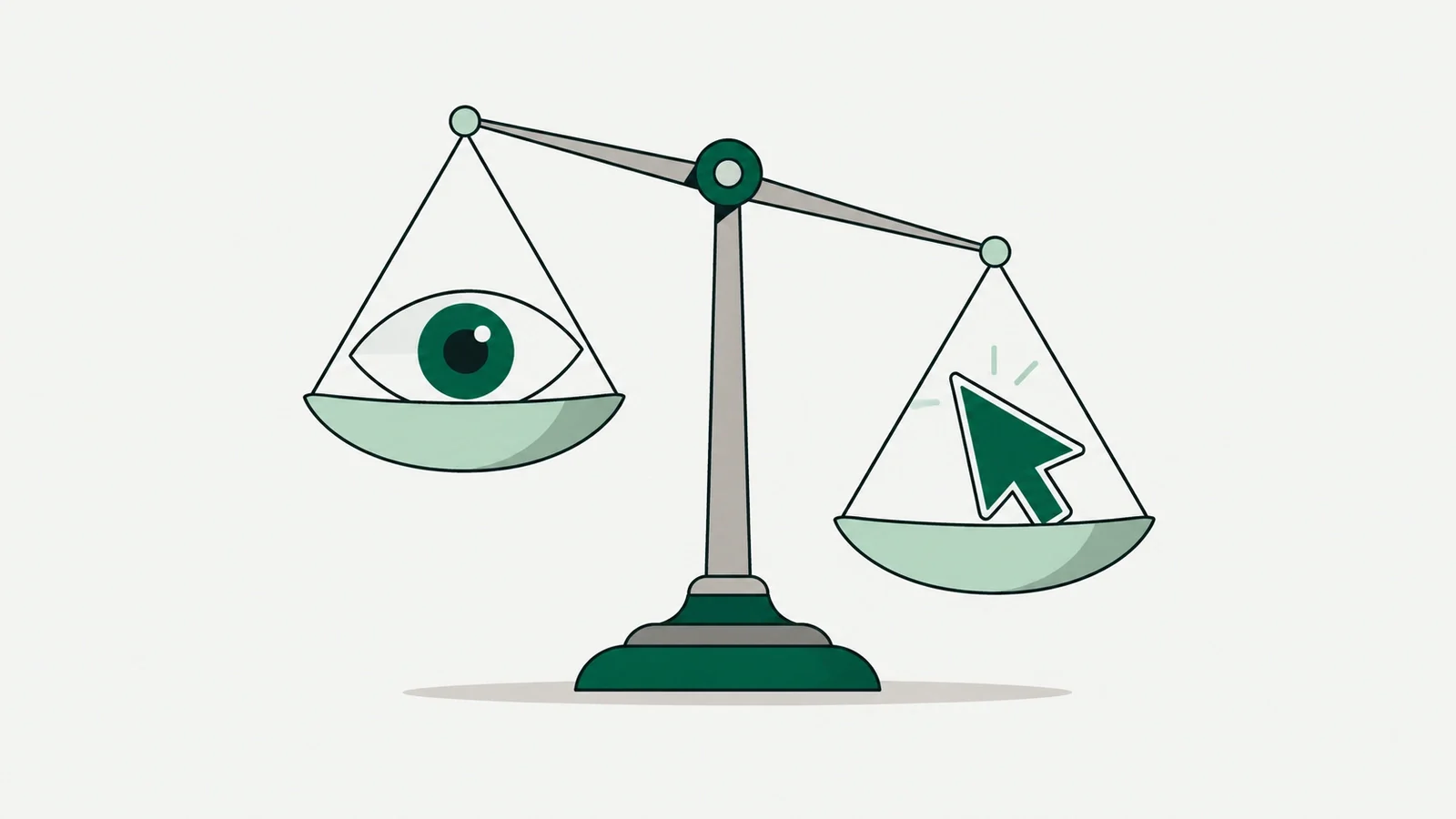
CPM (cost per mille) charges you for every thousand times your ad is shown. CPC (cost per click) charges you only when someone clicks. CPM is usually cheaper when your ad gets a high click-through rate, and CPC is safer when it does not. The two cost the same when CPC equals CPM divided by 1,000 times your CTR.
Key takeaways
- CPM is a price per thousand impressions. CPC is a price per click. Under CPM, you carry the risk that nobody clicks. Under CPC, the platform does.
- The break-even point is simple: CPM and CPC cost the same when CPC = CPM ÷ (1,000 × CTR).
- If your ad’s CTR is higher than the platform expects, CPM tends to be cheaper. If it is lower, CPC protects you.
- Platforms set prices to protect themselves, so a CPC price already assumes a typical CTR. The advantage goes to advertisers whose ads beat that assumption.
- Fixed-price listings, newsletter sends and ranking board positions are a third model: a flat price, where your cost per click depends on the clicks the placement delivers.
Most ad platforms let you choose, directly or through the objective you pick. Making the right choice can halve what you pay for the same visitors.
What you pay for
| CPM | CPC | |
|---|---|---|
| You pay for | Every thousand impressions | Each click |
| Who carries the risk of no clicks | You | The platform |
| Best when | Your ad is strong and your goal is reach or clicks you expect to win | You are testing, or your CTR is uncertain |
| Typical uses | Awareness, video, newsletters, display | Search ads, traffic campaigns, tests |
Search ads on Google are mostly sold per click. Social platforms and video often default to impression-based billing, sometimes optimized for a result such as a click or a conversion. X lets advertisers on the Engagements objective pay only when someone engages. Newsletters usually sell a flat fee or a CPM.
The break-even formula
The effective cost of a click under CPM is:
Effective CPC = CPM ÷ (1,000 × CTR)
So if a platform offers you a $6 CPM or a $1 CPC, the break-even CTR is:
CTR = CPM ÷ (1,000 × CPC) = $6 ÷ $1,000 = 0.6%
If your ad’s CTR is above 0.6%, CPM is cheaper. Below 0.6%, CPC is cheaper.
| CPM offered | CPC offered | Break-even CTR | If your CTR is 1% | If your CTR is 0.3% |
|---|---|---|---|---|
| $6 | $1.00 | 0.6% | CPM costs $0.60 per click | CPM costs $2.00 per click |
| $10 | $1.50 | 0.67% | CPM costs $1.00 per click | CPM costs $3.33 per click |
| $3 | $0.50 | 0.6% | CPM costs $0.30 per click | CPM costs $1.00 per click |
The figures in this table are examples to show the method. Use your own platform’s prices and your own CTR from a small test.
Why platforms usually win the average case
Platforms price CPC and CPM so that, for a typical ad, they earn about the same either way. A CPC price already assumes an average CTR. That means:
- If your ad is average, the choice makes little difference.
- If your ad is better than average, buying impressions lets you keep the benefit of your higher CTR.
- If your ad is weaker than average, paying per click shifts the cost of your weak ad to the platform.
Modern platforms complicate this by showing your ad more or less depending on its expected performance. A weak ad on CPC may simply be shown less. The principle still holds as a starting point.
A practical way to choose
- Start with CPC, or a click-optimized objective, while you learn your CTR.
- Measure your CTR on a few thousand impressions. Our guide to what is a good CTR gives benchmarks by channel.
- Calculate your effective CPC under CPM with the formula above.
- Switch to CPM if your effective CPC is clearly lower, and keep watching it. Creative fatigue lowers CTR over time.
The third model: fixed price
Some of the most useful placements for small products are neither CPM nor CPC. A newsletter send, a directory listing or a position on a ranking board has a fixed price. Your effective CPC is the price divided by the clicks the placement brings:
Effective CPC = fixed price ÷ clicks received
A $400 newsletter send that brings 160 clicks costs $2.50 per click. A $50 listing that brings 100 clicks costs $0.50. This is why click data matters so much when buying fixed placements: without it, you are buying blind. With it, you can set any fixed placement beside your CPM and CPC campaigns and compare directly. Our guide to cost per mille covers impression pricing in more depth, and our pillar on what a click costs on UpRank applies the same calculation to a ranking board.
Frequently asked questions
What is the difference between CPM and CPC?
CPM is a price per thousand impressions, paid whether or not anyone clicks. CPC is a price per click, paid only when someone clicks the ad.
Is CPM or CPC better?
CPM tends to be cheaper when your ad’s click-through rate is higher than the platform assumes. CPC is safer when you are testing or expect a low CTR.
How do I compare CPM and CPC?
Convert CPM into an effective cost per click with CPC = CPM ÷ (1,000 × CTR), then compare it with the CPC price on offer.
How do fixed-price ads compare with CPM and CPC?
Divide the fixed price by the clicks the placement brings to get an effective CPC, then compare it with your CPM and CPC campaigns.
Sources
The board
Put your product on UpRank
Your rank is your lifetime total, the cheapest spot is $1, and every listing shows the clicks it receives. Check what a spot costs today before you decide.