Short answer
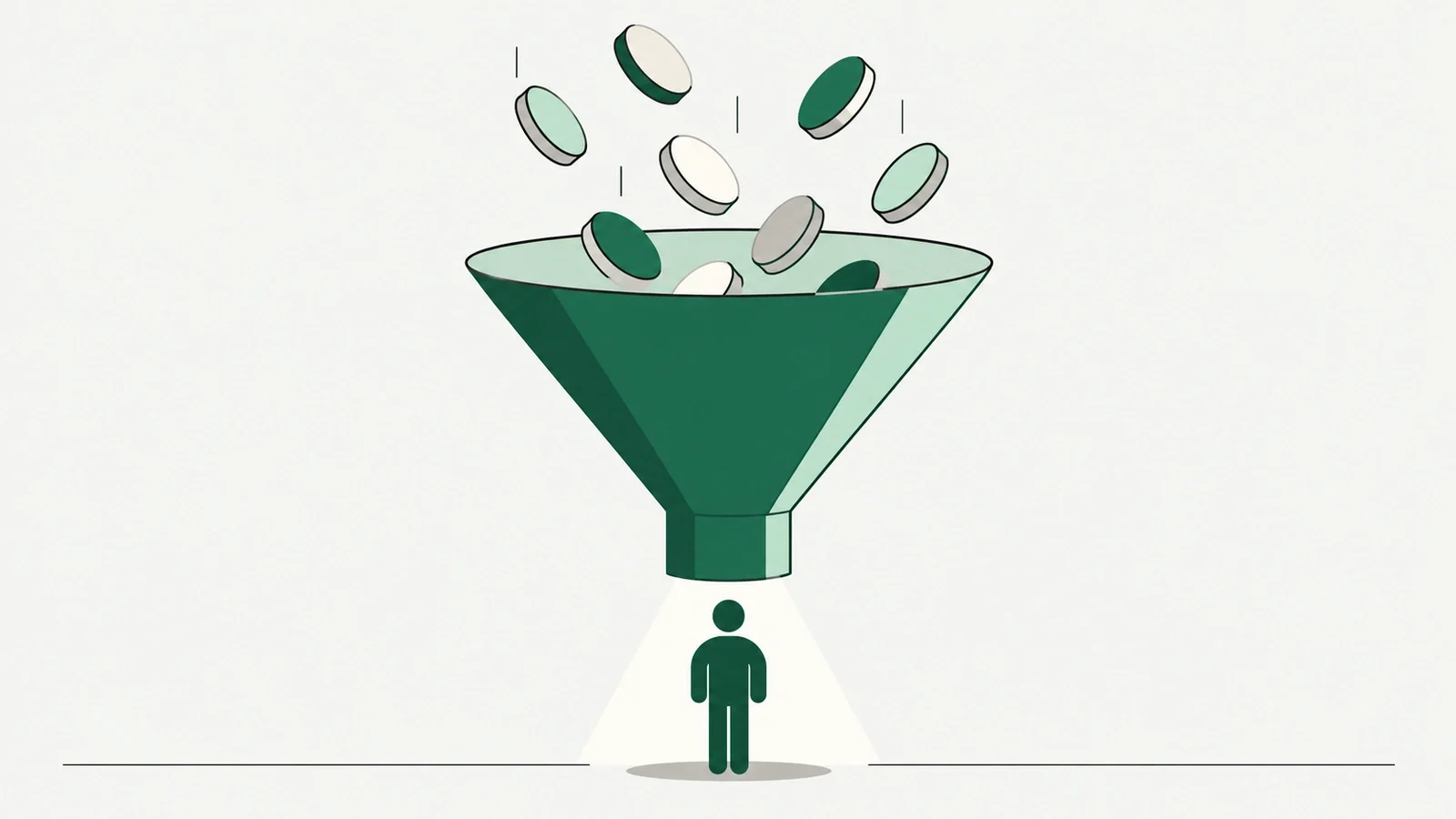
Cost per acquisition (CPA) is the amount you spend to get one result you care about, such as a sign-up, a trial, a lead or a sale. The formula is total spend divided by the number of acquisitions. If $500 of ads brings 20 trials, your CPA is $25 per trial.
Key takeaways
- Cost per acquisition (CPA) is total spend divided by the number of acquisitions, where an acquisition is whatever result you define: a sign-up, a trial, a lead or a sale.
- CPA is a campaign metric. Customer acquisition cost (CAC) usually covers all sales and marketing costs divided by all new customers.
- 2026 benchmarks: the median cost per lead was $66.69 for Google search ads and $27.39 for Facebook lead campaigns in WordStream’s US data.
- To compare channels, use the same definition of acquisition everywhere and count results in your own analytics, not only in each platform’s dashboard.
- A CPA is good only relative to what a customer is worth. Compare it with your revenue per customer, not with industry averages.
CPA is the number that lets you compare channels that charge in completely different ways. Google charges per click, Meta often per impression, newsletters per send, directories per listing and ranking boards per position. Turn each into a cost per acquisition and they finally sit on the same scale.
The formula
CPA = total spend ÷ number of acquisitions
The hard part is not the division. It is deciding what counts as an acquisition and making sure you count it the same way everywhere.
| Channel | What you pay for | Example spend | Acquisitions | CPA |
|---|---|---|---|---|
| Google search ads | Clicks | $600 | 12 trials | $50 |
| Newsletter placement | One send | $400 | 10 trials | $40 |
| Directory listing | One-time fee | $99 | 3 trials | $33 |
| Ranking board position | Position | $150 | 5 trials | $30 |
The figures in this table are illustrations, not benchmarks. The point is the method: every channel, whatever its pricing model, reduces to spend divided by results.
CPA versus CAC
The two terms are often mixed up.
- CPA usually refers to a single campaign or channel and the direct media spend behind it. It can measure any action, not only a paying customer.
- CAC, customer acquisition cost, usually means total sales and marketing costs, including salaries, tools and agencies, divided by the number of new paying customers in the period.
A channel can show a low CPA for trials and still produce an expensive CAC if few trials become customers. Track both: CPA to choose between channels, CAC to know whether the business works.
2026 benchmarks
Public benchmarks mostly report cost per lead, which is a form of CPA:
| Channel (US) | Median result | Source |
|---|---|---|
| Google search ads, all industries | $66.69 per lead | WordStream, 2026 |
| Facebook lead campaigns | $27.39 per lead | WordStream, 2026 |
| X (Twitter) ads | $21.55 median CPA | Agency dataset cited by RZLT, 2026 |
Leads campaigns: CVR 8.54%, CPL $27.39.
WordStream, Facebook Ads Benchmarks 2026, last updated September 14, 2026.
These numbers are useful as orientation and misleading as targets. A “lead” in a law firm’s campaign and a “lead” for a $9 app are not the same thing. Your own CPA, against your own customer value, is what matters.
What makes a CPA good
A CPA is good if the acquisition is worth more than it cost. A practical way to check:
- Estimate what a customer is worth. Average revenue per customer over the time they typically stay, minus the direct cost of serving them.
- Work out how many acquisitions become customers. If one trial in five becomes a paying customer, a $20 cost per trial means $100 per customer.
- Compare. If a customer is worth $300, a $100 cost per customer leaves room. If a customer is worth $60, the channel loses money, however cheap the clicks look.
Mistakes that flatter CPA
- Counting platform conversions only. Each ad platform tends to claim credit for conversions it touched. Count results in your own analytics, by source, to avoid counting the same customer twice.
- Ignoring the full cost. A newsletter sponsorship also costs the time to write the ad. A directory listing also costs the time to prepare it. For small tests, note the hours.
- Changing the definition. Measuring one channel by sign-ups and another by paying customers makes the comparison meaningless.
- Judging too early. Some channels, such as directories and content, keep producing results for months. Look at CPA after 30 days and again after 90.
- Too few results. Three acquisitions are not a CPA, they are an anecdote. Run tests long enough to reach a few dozen results where you can.
Tracking it properly
Give every channel a tagged link with a clear source name, so each visit is attributed in your analytics. Record the spend per channel and the acquisitions per channel in one sheet. Review monthly. Over time, that sheet becomes the most useful marketing document you have, because it tells you where the next dollar should go.
For typical costs per click and per impression across channels, see our guide to what it costs to promote a startup. To convert impression-based prices into comparable numbers, see cost per mille and CPM vs CPC.
Frequently asked questions
How do you calculate cost per acquisition?
Divide total spend by the number of acquisitions. If you spend $500 and get 20 sign-ups, your CPA is $25 per sign-up.
What is the difference between CPA and CAC?
CPA usually measures a single campaign or channel against any defined action. CAC usually covers all sales and marketing costs divided by all new paying customers in a period.
What is a good cost per acquisition?
One that is lower than what the acquisition is worth to you. Benchmarks help for orientation: in 2026, the US median cost per lead was $66.69 for Google search ads and $27.39 for Facebook lead campaigns.
How do I compare CPA across channels with different pricing?
Use the same definition of acquisition everywhere, attribute results with tagged links in your own analytics, and divide each channel’s spend by its results.
Sources
- WordStream, 2026 Google Ads Benchmarks, last updated May 19, 2026, accessed October 11, 2026
- WordStream, Facebook Ads Benchmarks 2026, last updated September 14, 2026, accessed October 11, 2026
- RZLT, X Ads in 2026: the cost, targeting and format playbook, September 29, 2026, accessed October 11, 2026
The board
Put your product on UpRank
Your rank is your lifetime total, the cheapest spot is $1, and every listing shows the clicks it receives. Check what a spot costs today before you decide.